The Hidden Superpowers of Rough-and-Tumble Play
Just like adults, children have conflicts. And when they do, they sometimes fight. But as adults, we know that there are lots of steps in between the one and the other. Deep communication skills, empathy, and emotional intelligence can all help us mediate situations that may not actually be conflicts – but could escalate into them.
How do we begin to develop these abilities when our brains are very young – before we’ve got a full toolbox of skills in verbal communication, reading, and listening? One thing we use at St. George’s to help our children remain emotionally calm in chaotic situations is rough-and-tumble play. Rough-and-tumble play (or “RTP” in early childhood shorthand) supports fitness and coordination, sure. But it also sharpens key skills in nonverbal communication and empathy.
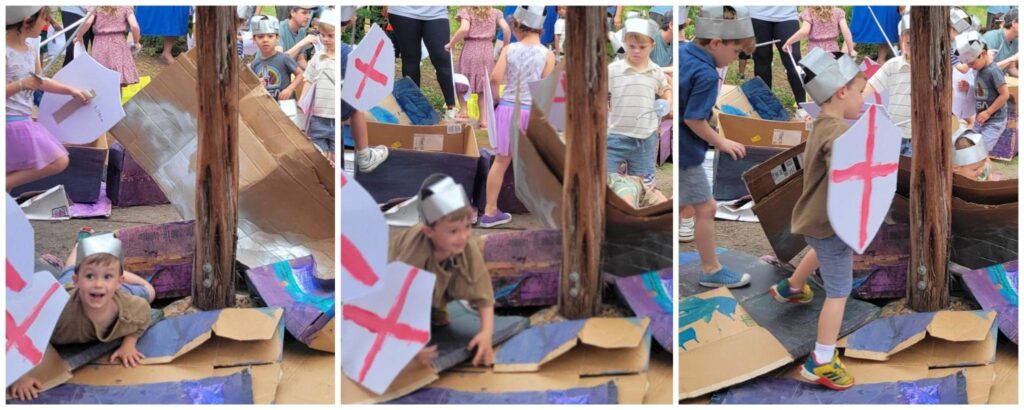
During events like our yearly “Slaying of the Dragon,” it may look like children are just getting riled up.
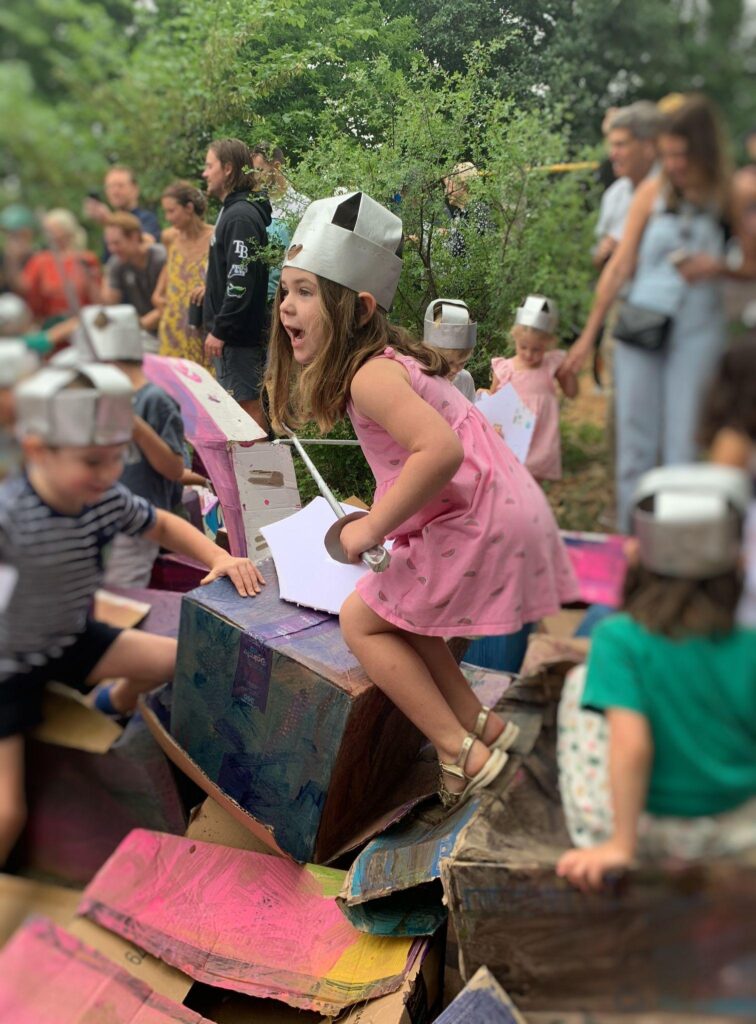
RTP can sometimes crescendo, especially if children with big personalities start to feed off of each other all at once. And naturally, some children will tend to keep their distance, skirting around the edges of the action or staying quiet.
But studies have shown that children need RTP experience to learn emotional control and restraint in situations that may be competitive or conflictual. And even though the dynamics of how this growth takes place in real time can be complex, it doesn’t take rocket science to understand why the growth itself is pivotal.
When children begin learning emotional regulation and nuanced listening at a young age, they’re beginning to gather the tools they need for healthy relationships.
What is Rough-and-Tumble Play … and What’s Not?
“There are strong physical benefits to RTP, absolutely. But the cognitive aspect is important, too,” says Head of School Jerri Thompson, M. Ed.. “Studies have shown that chemicals are released in areas of the brain responsible for decision-making and social comprehension. The midbrain, lower forebrain, and cortex all light up.”
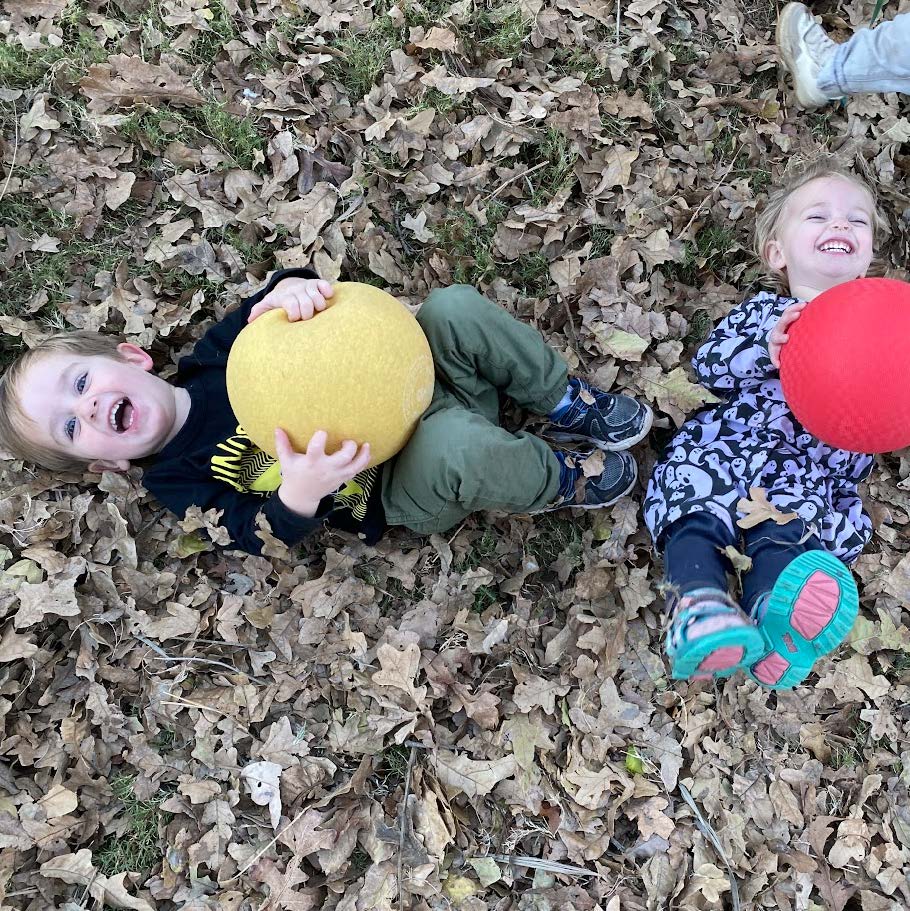
Thompson refers to studies by longtime ECE expert Frances Carlson. Pointing out, fascinatingly, that accounts of children engaging in RTP date back to the 12th century AD, Carlson defines it with the array of behaviors children display when they’re doing it. There’s often chasing, tagging, swinging around, throwing to the ground – and, importantly, a lot of smiling and laughing.
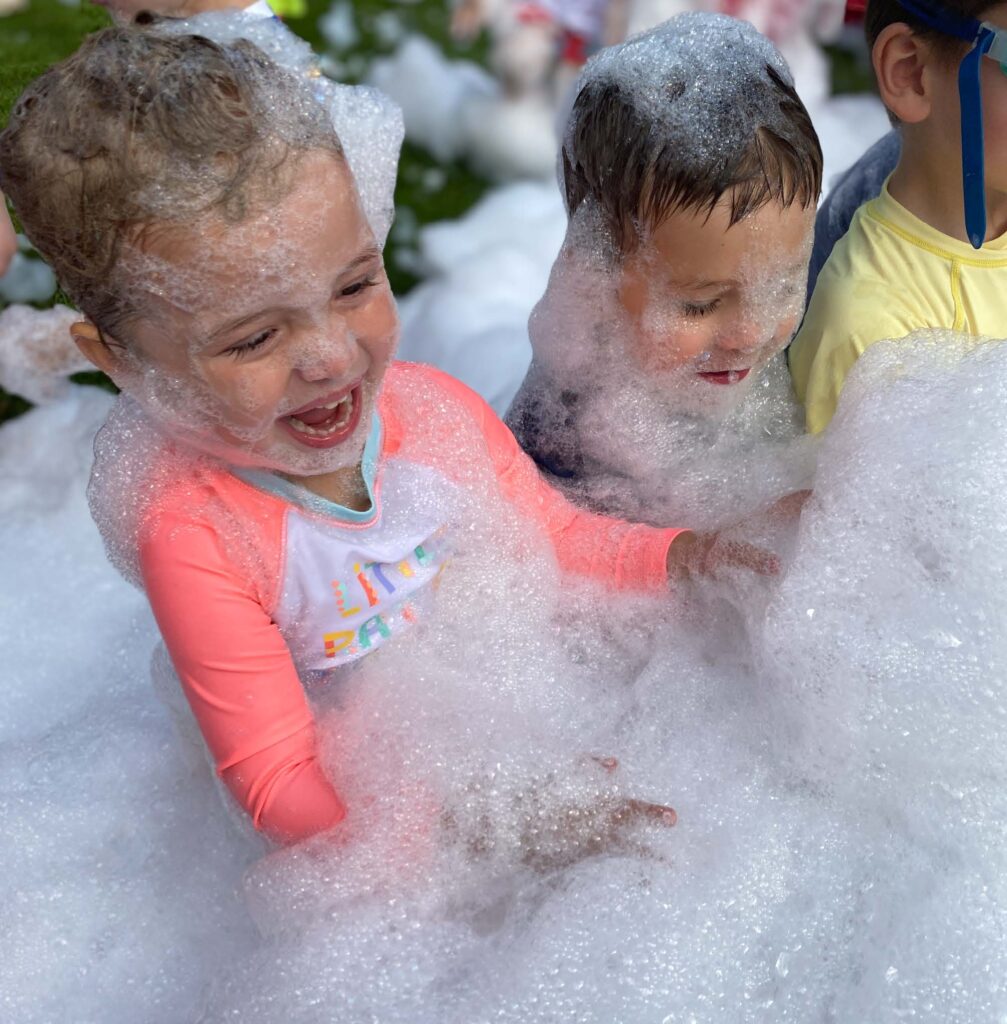
And that’s the special sauce, Carlson says. By definition, rough and tumble play is when
children willingly:
- laugh
- run
- jump
- open-hand touch (tag)
- wrestle
- chase, and
- flee
It’s possible to discern RTP from aggression, because children being aggressive typically:
- fixate
- frown
- hit
- push, and
- grab-and-take
Children at St. George’s are allowed to self-guide their RTP experience so that they can learn how to keep one from becoming the other.
The Sprouts of Social Cues
“RTP encourages children to negotiate and cooperate with others. There’s a lot of give and take,” Thompson observes. “It requires children to create agreements and problem-solve, sometimes by talking it out or by becoming aware of facial expressions.”
On the deepest level, RTP is about learning to send and receive signals.
“Successful participation in this play requires children to become adept at both signaling and detecting signals — a social skill they will need and use throughout their lives. When detecting these signals, they are learning to read and understand the body language signifying when play should come to an end,” Carlson says.
Throughout the course of a session, children will also often encounter prompts to change roles, and decisions about whether to do it. It’s as simple as a game of tag, Carlson points out, but it’s also a bedrock skill in society.
Sometimes a child chases; sometimes they get chased. It only works when there’s a dynamic of give-and-take, which mimics successful social conversations and interactions between adults. It’s “social practice,” Carlson suggests – a way to build the social knowledge they’ll need for future relationships.
And before we forget that it all starts with running around and getting physical, there’s an important link between the physical and emotional benefits of RTP.
“Socially, children develop a strong sense of self when engaged in RTP because self-concept begins with body awareness. By understanding how our body moves in space and how our body can affect others, we begin to develop empathy,” Thompson says.
Right, But Isn’t it Dangerous?
The main worry about rough-and-tumble play? That it’s exactly what it sounds like – rough. And though it’s more than understandable to worry about your child getting hurt, research doesn’t support it. RTP generally takes place between friends, school bullying expert Peter K. Smith, Ph.D., points out. And it very rarely leads to actual fighting or injury.
Our staff watches this kind of play closely, with safety as the primary objective.
For teachers and even parents, it starts with a clear understanding of the differences between rough-and-tumble play and fighting. (Recall Carlson’s bulleted lists above.) Once that’s established, chaperones can watch for important cues to anticipate any problematic situations, and be in the right place if needed.
- Watch for your child’s facial expressions and teach other children how to watch for those same cues.
- One marker for RTP is that children are willing to participate and return to play again and again. Pay attention to every child’s willingness to participate. Be ready to redirect, guiding children on what to do if another child doesn’t want to play.
- Redirect example: “So-and-so doesn’t want to play that way anymore – Let’s go play with so-and-so instead.”
As children grow, RTP can turn into play fighting. The precursors to this take place at St. George’s, where preschoolers are starting to grapple with the concepts of good and evil during play. Luckily, almost no play fighting during RTP turns into real fighting. Dr. Eileen Kennedy-Moore, writing for Psychology Today, referred to studies that found only 1% of play fights between elementary school boys turned into real fights.
Learning, Growing, Evolving
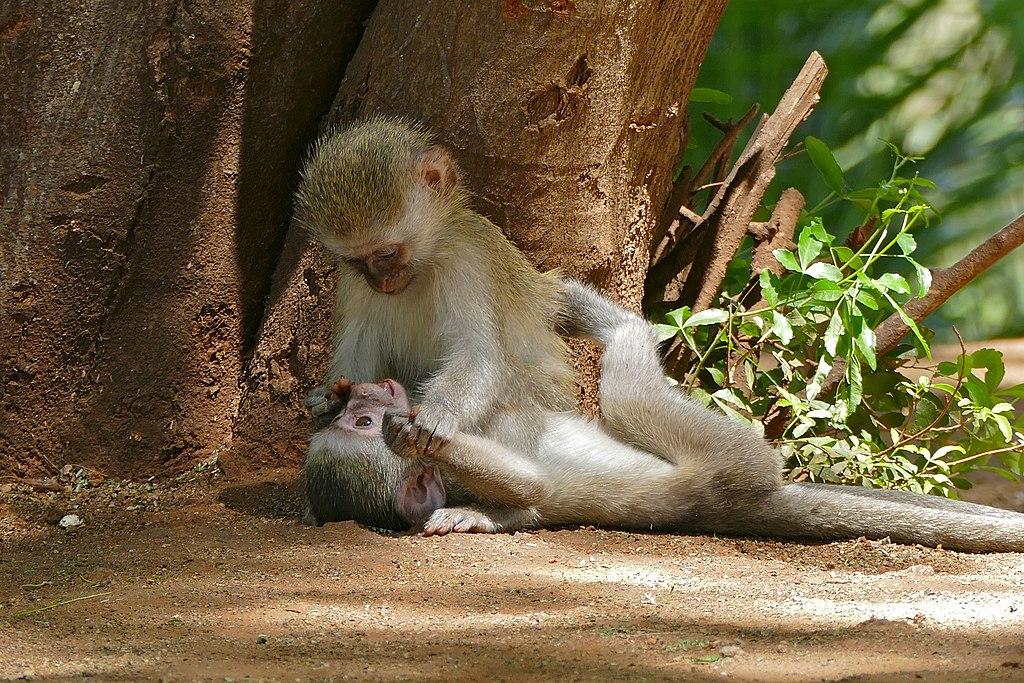
Finally, RTP is perfectly natural. Think about puppies and kittens chasing each other around, rolling, biting, and pouncing. Human infants even engage in it, grabbing each other’s hands and feet, or rolling on top of each other.
“Teachers and parents have mixed feelings about RTP. Some feel like it promotes violence or bullying, but the opposite is more accurate,” Thompson says. “Evolutionarily, this type of play creates critical brain pathways vital for adaptive responses to aggression, dominance, and self-defense. It also prepares children for understanding hierarchical status without jealousy or unhealthy competition. Accepting our strengths and weaknesses and those of others creates a model for true tolerance.”
With the proper guidance and a foundational understanding of child development, we can use RTP as another avenue to guide young children through their journey into healthy, balanced adulthood.